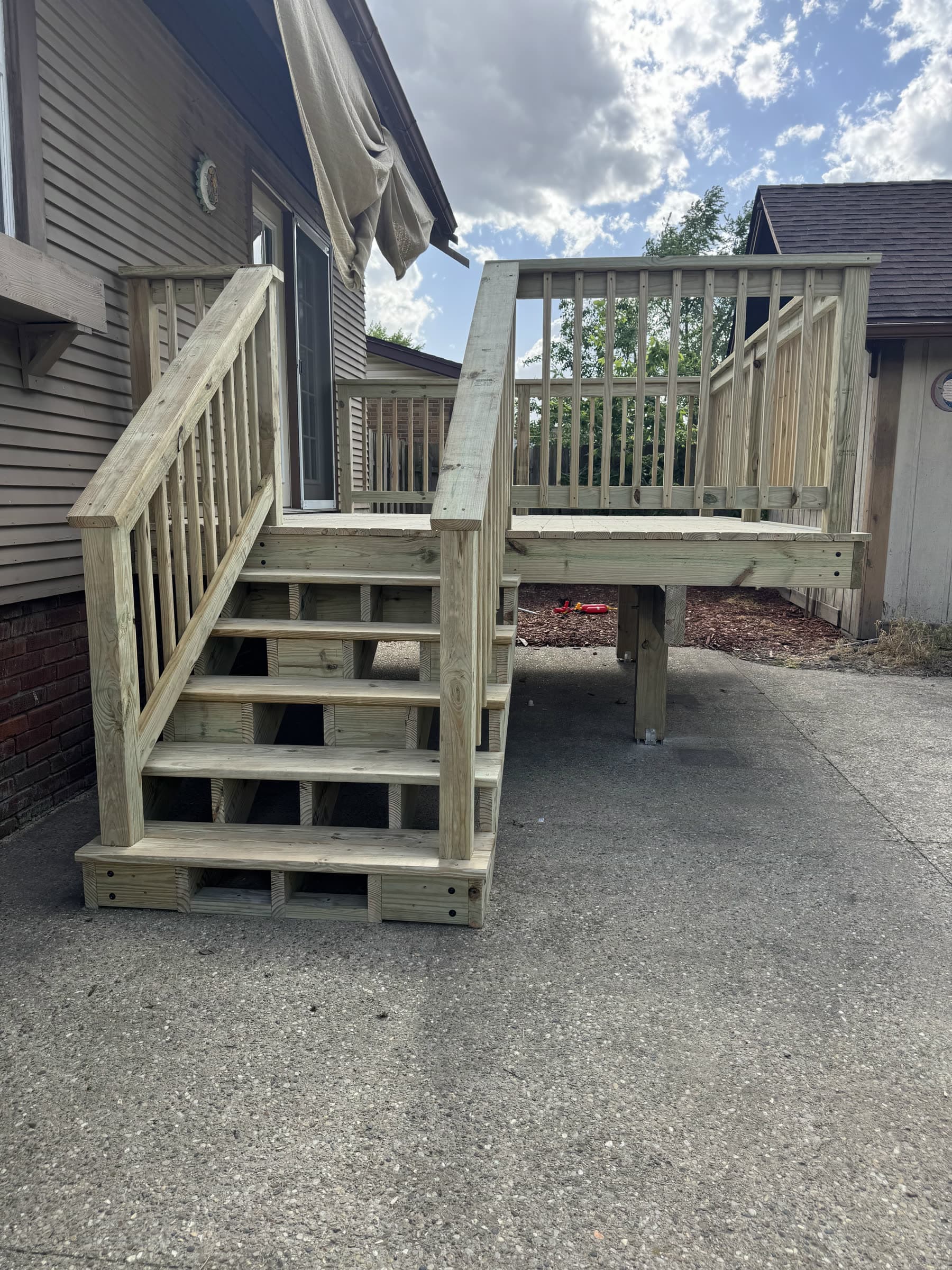

Decking · Permits
What the counties ask for before you build a deck
Xcel Outdoor Living builds decks across the Illinois Valley out of Spring Valley, Illinois, serving Bureau, LaSalle, Putnam, Marshall, and Lee counties. On the land those five counties zone, a residential deck needs a permit, and each of the five arrives at that answer by a different route.
That is worth knowing on its own, because a deck and a fence get opposite answers from the same office. The permit is ours to pull and the fee is already inside the number you were quoted, so none of this is a job for you. It still shapes the deck. What the office with your address asks for can decide how high it sits off the ground and whether it counts as a structure at all.
About 12 minutes to read
A deck and a fence get opposite answers from the same office
If you have already been through this for a fence, put that answer down. It will mislead you.
All five counties in our service area require a permit for a residential deck on the land they zone. Not one of them gets there the same way, and three of them exempt a residential fence in the same breath:
- Bureau County names decks first in the list of projects needing a building permit, and the exemption list at section 11.17 does not include them. That same exemption list does include the construction or alteration of a fence in a residential district. Two lines in one section, opposite answers.
- Putnam County is explicit at 20.05(B): detached garages, swimming pools, decks, patios, gazebos, porches, walls or fences in commercial and industrial districts, and other miscellaneous accessory structures require building permits. Its exemption list at 20.08 runs to four items, one of which is residential fences. Decks are not on it.
- Marshall County makes the split structural. Its definition of "Structure" at section 1.2 covers anything constructed or erected which requires location on the ground, and then ends with the words "excluding a fence." A deck sits inside that definition. A fence is written out of it.
- LaSalle County removes the argument in advance. Its definition of structure at 2.1(12) names decks in terms, alongside in-ground pools, porches and gazebos.
- Lee County reaches the same answer without ever using the word. No document the county publishes names a deck anywhere. The requirement rests on scope language instead: the Building Permits page (opens in a new tab) states that the Building Permit Application covers "ANY STRUCTURE other than a Fence or Pool," those being the only two structure types routed to their own forms.
So the sentence to carry away is a short one. A fence in this area is a zoning question and is sometimes exempt. A deck is a structure and is almost never exempt. Do not let a friendly answer about a fence stand in for an answer about a deck, and do not let it work the other way either.
The other half of the jurisdiction question is the same as it is for a fence permit. A county ordinance governs the land the county zones, and it stops at a corporate limit. Marshall County is the exception that proves it: its ordinance at 2.1-5(A) reaches the unincorporated area and also any municipality inside the county with no zoning ordinance of its own.
Only one of the five counties publishes a size you can get under
"It is only a small deck" is not an argument in four of these five counties, because four of them publish no size floor at all.
LaSalle County (opens in a new tab) is the exception, and the wording of its exemption is worth reading slowly because it is the opposite of how people assume it works. Section 4.2(c) exempts a structure that both does not exceed 200 square feet and has a lineal length of any side of less than 20 feet. Both conditions have to hold. A deck six feet by twenty-two feet comes to 132 square feet, which clears the first condition comfortably, and has a 22 foot side, which fails the second. It needs a permit.
That is a long narrow deck along the back of a house, which is one of the most ordinary shapes there is. If you are anywhere near either figure, do the arithmetic on both.
The other four counties are silent on size, and one of them makes the silence look deliberate. Lee County does use size thresholds where it wants them: it publishes a lighter permit for a utility shed under a stated square footage. It did not write one for decks.
What a county permit actually certifies, which is less than you think
This is the section most homeowners have never been told, and it changes what a permit is worth to you.
Three of the five counties have adopted no residential building code at all.
- Bureau CountyHas adopted no building code. The permit and the inspections that follow it test compliance with the Zoning Ordinance and the Floodplain Ordinance, not structural code compliance.
- Marshall CountyFormally a non-building-code jurisdiction. The permit is a zoning review of placement and coverage, not a structural plan review.
- Lee CountyNo building code of its own. The permit form states that in the absence of one, plans are reviewed against the most current BOCA, International Building Code, or National Electrical Code.
- LaSalle CountyThe opposite case. It enforces a current edition of the residential code and publishes its own one page Residential Deck Construction Guide, so its structural expectations are stated in plain language rather than left in the code book.
- Putnam CountyRequires the permit and names decks in the ordinance. Its zoning ordinance is published as an image scan with no text layer, which is a real obstacle to reading it and a real reason to ask the Zoning Office rather than rely on a summary.
In several of these places, a permit is proof that the deck is allowed to sit where you put it. It is not proof that anybody looked at how it was framed.
Which is an argument for the permit, not against it, and also an argument for getting the construction specified in writing rather than assuming an inspector will catch what a contractor got wrong. That case is made properly in how to read a fence quote, and it holds for a deck exactly as it holds for a fence.
One thing this page will not do is tell you how deep a deck footing goes. Xcel sets fence posts below the frost line, which is a fence claim and is stated as one. A deck footing carries a live load down into the ground and is governed by whatever code your jurisdiction reviews against, or by the contractor's own practice where there is no code. Ask about it as its own question when you talk through the build, and do not let a fence answer stand in for a deck answer.
How far off the ground the deck sits can change what it legally is
How far the walking surface sits above the ground is not a cosmetic decision. In some jurisdictions it decides what the deck legally is.
The clearest version is Peru's, and it is unusually crisp for a zoning ordinance. Under 10.01(d)(3)(b) and 10.01(d)(4)(b), both amended by Ordinance No. 4564 in December 2008, decks and terraces more than sixteen inches above ground level are accessory structures, and decks and terraces sixteen inches or less above ground level are considered as patios and not as accessory structures at all. One measurement, two regulatory identities, and everything that follows from being an accessory structure comes with it.
The model residential code takes a similar approach at a different height. Its permit exemption list covers a deck not more than thirty inches above grade that is not attached to a dwelling and does not serve the required exit door. Homeowners find that exemption online constantly, and it is real, and it is also entirely optional for the town adopting the code.
Dixon is the proof. The city adopts the residential code and then rewrites its permit exemption list in full at 7-4-2(D). The replacement list contains four items: finish work, small prefabricated above-ground pools, swings and playground equipment, and window awnings that do not project past a stated distance. Neither the deck exemption nor the fence exemption survives, and the word "deck" appears nowhere in that section. So the exemption a homeowner reads in the model code has been deliberately deleted in the city they live in.
Two more towns handle the same idea as a projection rather than an exemption, which is worth recognising if your deck runs into a required yard. Oglesby's projection table treats porches and decks that are not over three feet, open on three sides and three feet off any line as permLacon to project. Lacon goes further: an unroofed terrace is not counted as part of the structure for lot area purposes, and an unenclosed one-story porch on piers may project up to six feet into a required front, side or rear yard so long as it stays at least four feet from any lot line.
So the question to bring to the office is not only how big. It is how high, whether it is attached, and how many sides are open.
The second permit nobody expects, and where it applies
A floodplain permit is a separate permit. It is not a box on the building permit, it is a second application to a second process, and this is a river valley.
Where it turned up in the research:
- Henry. Section 18-85 provides that no person shall commence any development in the Special Flood Hazard Area without first obtaining a development permit. Much of the city sits against the Illinois River.
- Lacon. Section 151.05(A) requires a separate development permit from the City Zoning Officer before any development in the floodplain, and the definition of development at 151.02 expressly includes the construction or erection of levees, dams, walls or fences.
- North Utica. Section 10-12-5(A) prohibits commencing any development in the floodplain without a development permit. The village states that most of the old part of Utica sits in the 100-year floodplain of the Illinois River and Clark's Run Creek, and the maximum impervious coverage allowed on a lot drops when the lot is inside it.
- Ottawa. Deck work inside the mapped regulatory floodplain needs a separate Floodplain Development Permit.
- Lee County. Its Development Manual defines development broadly enough that the definition reaches, in the county's own words, any man-made change to real estate.
There is a limit to what we can tell you here. The floodplain layer was documented thoroughly on the decking side of this research and not on the fencing side. In five jurisdictions the deck research found a separate floodplain development permit and the fence research did not address the question in either direction. Several of those ordinances define development broadly enough that a fence in a mapped flood hazard area plausibly needs the second permit too, and we could not confirm it. Mendota is the one place where the fence answer is published and it is absolute: under 340-17.1(D), fences may not be built in the 100-year floodplain under any circumstance.
So if your property is near water, ask about the floodplain permit for whatever you are building, and ask it as a separate question. If you are not sure whether you are near enough for it to matter, FEMA's Flood Map Service Center (opens in a new tab) is the official public source for the mapped flood hazard information these ordinances are pointing at, and it takes an address.
Registration, inspections, and two questions worth asking
Two practical layers sit between the permit and the first board, and neither is obvious from the ordinance.
The first is contractor registration. Several jurisdictions here make it a precondition to the work happening at all, not a formality afterwards. Oglesby's Land Development Code at 14-11-19(C)(11) provides that no contractor may perform any work on a project requiring a building permit until that contractor has applied for and received a city licence, and requires every permit to designate one general contractor responsible for permitting only licensed contractors on the job. The City of LaSalle publishes its own list and states that a contractor who is not on it is not allowed to be providing services for hire. Peru requires all contractors, residential and commercial, to be registered to work within the city. Dixon operates a registration with a mandatory bond and insurance. Lee County's registration is a one-time lifetime charge covering all trades other than roofing and plumbing, and registered contractors have to keep their licence and insurance dates current with the county.
None of that is a reason for alarm and all of it is a fair question to put to anyone quoting you a deck: are you registered in the town or county where I live, and is it current. A straight answer takes ten seconds.
The second is the sequence of inspections, and it varies with the answer in the last section. Where a county has adopted a residential code there is a real inspection chain, and LaSalle County routes scheduling through a third-party inspection service rather than through county staff. Where a county has adopted none, the inspections that exist are checking placement and coverage. Ask what will be inspected and when, and ask specifically whether anything has to be looked at before it is covered up.
One last practical note, from the town that states it most bluntly. Mendota's Building Permit Handbook says work cannot begin until the permit has been submitted, paid for and obtained, that permits must be displayed and viewable from the street, and that if work begins without the approved displayed permit a stop work order will be issued and fines assessed. That is the strictest published version of a rule every one of these jurisdictions has in some form.
What each of the towns we serve asks for is on that town's own page, and those pages answer the fence question rather than the deck one. That is the contrast this guide opened with, so the towns doing the most work above carry a different answer on their own page: Peru, Dixon and Mendota. The shape of the fence answer across the whole area is in the fence permit guide. The estimate is free, so if you want to walk the ground and talk through what the county will be looking at, that costs you nothing.
Related questions
Do you need a permit to build a deck in the Illinois Valley?
On the unincorporated land each of the five counties zones, yes. Bureau, LaSalle, Putnam, Marshall and Lee counties all require a permit for a residential deck, and only LaSalle County publishes a size below which one is not needed. Inside a city or village the county's answer does not apply and the municipality's does, so establish which government has your parcel first. At least one town in this area publishes no general permit trigger of any kind, which is a reason to call rather than to assume the answer either way.
Is there a size of deck that does not need a permit?
In four of these five counties, no. LaSalle County is the exception and its exemption is written as two conditions that must both hold: the structure must not exceed 200 square feet and every side must be less than 20 feet. A deck six feet by twenty-two feet is only 132 square feet but it has a 22 foot side, so it is not exempt. Lee County is the useful counter-example, because it does use size thresholds where it wants them, publishing a lighter permit for a small utility shed, and it did not write one for decks.
Does a deck permit mean somebody checks that the deck is built properly?
Not necessarily, and it is worth knowing before you rely on it. Bureau County has adopted no building code, so its permit and the inspections that follow test compliance with the Zoning Ordinance and the Floodplain Ordinance rather than structural soundness. Marshall County is formally a non-building-code jurisdiction and its permit is a zoning review of placement and coverage. Lee County has no building code of its own and states on its permit form that plans are reviewed against the most current BOCA, International Building Code or National Electrical Code. LaSalle County is the opposite case, enforcing a current residential code and publishing its own deck construction guide.
Does the height of a deck off the ground change anything?
It can change what the deck legally is. Peru treats a deck or terrace more than sixteen inches above ground level as an accessory structure, and one at sixteen inches or less as a patio which is not an accessory structure at all, so the same physical object falls under two different sets of rules depending on that one measurement. The model residential code carries a permit exemption for a deck not more than thirty inches above grade that is not attached to the dwelling and does not serve the required exit door, but a town that adopts that code is free to delete the exemption, and Dixon did.
Do I need a second permit if the deck is near the river?
Possibly, and it is a genuinely separate permit rather than a section of the first one. Henry requires a development permit before any development in the Special Flood Hazard Area, and much of the city sits against the Illinois River. Lacon requires a separate development permit from the City Zoning Officer. North Utica states that most of the old part of the village lies in the 100-year floodplain and reduces the maximum impervious coverage allowed on a lot inside it. Ottawa requires its own Floodplain Development Permit for deck work inside the mapped regulatory floodplain. If you are anywhere near water, ask about this specifically rather than assuming the building permit covers it.
Xcel Outdoor Living builds fences and decks across Bureau, LaSalle, Putnam, Marshall, and Lee counties, Illinois. Call 815-579-2323 to walk your yard.