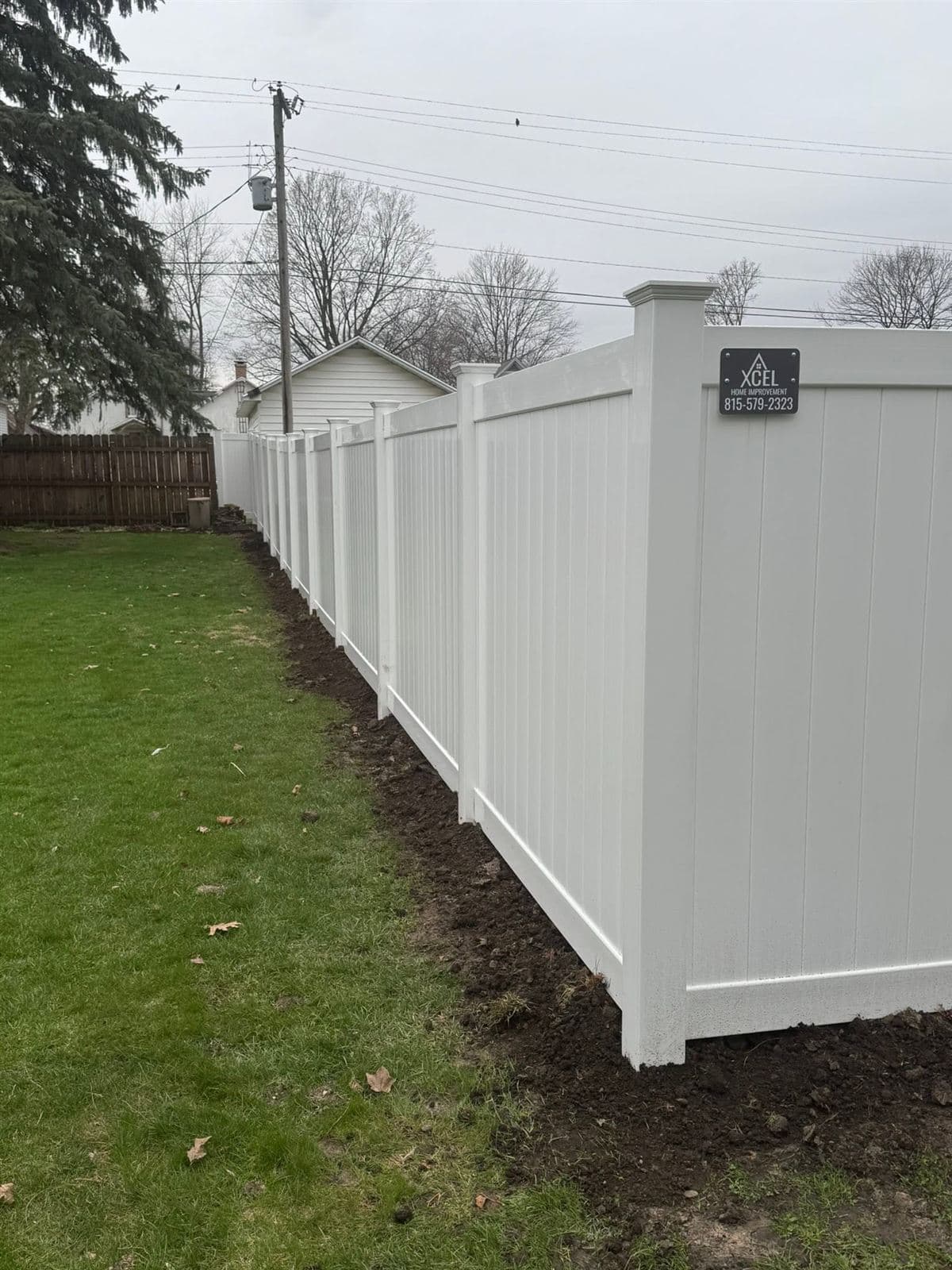

Fencing · Process
How to read a fence quote
Xcel Outdoor Living quotes and builds fences across the Illinois Valley out of Spring Valley, Illinois, serving Bureau, LaSalle, Putnam, Marshall, and Lee counties.
Almost every article about comparing fence quotes tells homeowners to demand an itemized breakdown. This guide argues the opposite, because an itemized quote can describe a bad fence in perfect detail, and a single-number quote with real specifications attached cannot.
About 7 minutes to read
What “fence materials: $4,200” actually tells you
Nothing you can use.
It tells you how one contractor split a number he had already decided on. It does not tell you the wall thickness of the vinyl, the wire gauge on the chain link, the species or treatment on the wood, the size of the posts, or how deep those posts go. Two contractors can both write “fence materials: $4,200” and build fences that will not look the same in year eight.
Here is the test. Take an itemized quote and try to hold somebody to it. Labor came in at $2,800. What promise is that? If the gate sags in the second summer, no line on that page says the gate was going to be cross-braced. If a post heaves, no line says it was going to clear the frost line. You have a receipt for a number, not a description of a fence.
Now take a single-number quote that names the post depth, states that the depth clears the frost line, gives the post size and the material’s wall thickness, says the gate leaves are framed and cross-braced on adjustable hinges, states who backs the warranty and what it excludes, and says who hauls the old fence away. You still do not know how that contractor split his margin. You know exactly what is going in your yard, and every one of those statements can be checked against the finished job with a tape measure and a walk down the line.
The itemized quote is more transparent about the money. The specified quote is more transparent about the fence. Only one of those is still standing in ten years.
Specifications protect a buyer. Line items do not.
A specification is a promise about a physical thing. A line item is an accounting split of a total you already have.
That distinction does the real work. You can walk out to the fence and verify a specification. You can measure a post. You can look down a run and see whether it holds a line. You can grab a gate and feel whether the frame carries its own weight. There is no way to walk out to your fence and verify that labor was $2,800.
Itemizing also moves the conversation to the wrong place. Once you have four categories on a page, you start asking which one can come down. That is a negotiation about the split, and the split is not what determines whether the fence lasts. The conversation that matters is about what goes in the ground and what holds the gate up. Every hour spent squeezing a materials line is an hour not spent asking about post depth.
This is not an argument against knowing what things cost. It is an argument about which question buys you protection. Ask what you are getting, in physical terms, in writing. Then compare the totals of quotes that describe the same fence.
If a contractor will not put his specifications in writing, that tells you something. If he will, you have a document you can hold him to. Neither of those outcomes depends on whether the price was split into four lines.
The specifications worth asking for
Ask for these in writing before you sign anything. Any fence contractor should be able to answer all of them on the spot.
- Post depth in inches, and whether it clears the frost line. This is the specification that decides whether the fence is still straight in year ten.
- What the post is set in, and how the hole is backfilled.
- Material grade. Wall thickness on vinyl and aluminum. Wire gauge on chain link, where a lower number means thicker wire. Species and treatment level on wood.
- Post and rail dimensions, and picket spacing.
- Gate construction. Whether the leaves are framed and cross-braced, what the hinges are, whether they adjust, and how a double drive gate is held open and closed.
- Slope handling. Stepped or racked, and which one your yard is getting.
- Warranty terms. What is covered, what is excluded, whether it is the manufacturer’s promise or the installer’s, and who honors it if the company changes hands.
- Site work. Who hauls the old fence, who fills the spoil, what the yard looks like when the crew leaves.
- The utility locate. Digging in Illinois requires one. The statewide one-call service is JULIE (opens in a new tab), reached at 811. Ask who is placing that call. On a well-run job the contractor files it and schedules the dig around the marks.
- Permits and approvals. Many towns here require a permit before a fence goes up. Ask who pulls it and whether the fee is already in the number you were given. Some towns want the property owner’s signature on the application no matter who files it, and an HOA approval, if you have one, stays in your name.
Comparing two quotes without guessing
Common guidance is to collect three bids, and that holds up. It only works if you compare like for like.
- Put the specifications side by side, not the totals. One column per contractor, one row per item from the list above. The gaps will show up fast, and the empty cells are the most informative part of the page.
- When one bid is far cheaper, find the specification that differs. It is almost always depth, post size, or gate construction. Occasionally it is that the cheap bid quietly dropped a gate or shortened the run.
- Check that the scope actually matches. Read the linear footage on each. Count the gates. See who is hauling the old fence away and who expects you to.
- A quote with no written scope is not a quote. It is a number somebody said out loud.
If two contractors describe the same fence and one is meaningfully cheaper, that is useful information and you should take it seriously. The problem is that most homeowners never get to that comparison, because nobody wrote down what either fence was.
What the money terms should look like
These are published industry norms, not Xcel’s terms. They are worth knowing because they give you a baseline to measure any contractor against, this one included.
- Deposits in the range of 25 to 35% at signing are commonly described as standard for a job of this size. A deposit is normal. It covers material that gets ordered for your yard specifically.
- More than 50% up front is widely treated as a warning sign. A contractor who needs most of the money before the first post goes in is telling you something about his cash position.
- Payments tied to milestones beat payments tied to dates.
- Get the payment schedule in writing before work starts, alongside the specifications.
Ask any contractor you are considering what his deposit and payment schedule are, and compare them against those norms yourself.
Red flags that have nothing to do with price
- A warranty that only exists out loud. If the coverage, the term, and the exclusions are not written on the document, there is no warranty. A vague warranty is worse than no warranty, because it makes you stop asking.
- “We can start tomorrow.” In season, a good crew is booked. Instant availability is a question worth asking about, not a bonus. Published guidance on vetting contractors treats a lead time of a few weeks as a healthy sign and same-day availability as a reason to look closer.
- Hedging on the spec questions. A contractor who cannot tell you how deep his posts go has either not thought about it or does not want to commit to it. Both are answers.
- Pressure to sign today for a price that expires today. Materials pricing moves, and a quote can honestly carry an expiry. A discount that vanishes at the end of the visit is a different thing.
- No proof of insurance (opens in a new tab) when you ask. Ask. It is a normal request and a straight answer takes ten seconds.
The good signs are quieter. A crew that is booked out. A contractor who answers depth questions without pausing. Exclusions written down instead of glossed over. Somebody who tells you what the warranty does not cover before you ask.
Related questions
Should I ask for my fence quote to be itemized?
Ask for the specifications instead. An itemized quote tells you how the contractor split his number. A specified quote tells you what is going in your yard. If you want both, ask for the specs first, because that is the one you can hold somebody to.
How many fence quotes should I get?
Three is the common recommendation and it works well. The value comes from the comparison, so get all three to describe the same fence. Three totals with no specifications behind them will not tell you anything except which contractor is cheapest, which is not the question you were trying to answer.
Is a deposit normal on a fence job?
Yes. Published guidance puts 25 to 35% at signing in the standard range, and over 50% up front is widely treated as a warning sign. Materials for your yard get ordered before the crew shows up, and the deposit covers that. Ask any contractor for his terms in writing.
Why is one quote so much cheaper than the others?
Usually because it describes a different fence. Shallower posts, lighter material, a gate without a braced frame, or a scope that quietly lost something. Occasionally it is a genuinely leaner operation. You cannot tell which without the specifications, which is the whole reason to ask for them.
What should be in writing before work starts?
The scope, the specifications from the list above, the warranty terms with exclusions, the payment schedule, and who is responsible for the utility locate and for hauling the old fence away. If it matters to you and it is not on the page, it does not exist.
Xcel Outdoor Living builds fences and decks across Bureau, LaSalle, Putnam, Marshall, and Lee counties, Illinois. Call 815-579-2323 to walk your fence line.