
Decking · Materials
Wood or composite decking, compared
Xcel Outdoor Living builds decks in both wood and composite across the Illinois Valley, out of Spring Valley, Illinois, serving Bureau, LaSalle, Putnam, Marshall, and Lee counties. Industry figures put composite at roughly 40% of new residential deck installations, up from about 25% a decade ago.
This guide covers what actually changes when you pick one over the other, including a warranty catch that most deck pages leave out and this one does not.
About 8 minutes to read
Where the market went
A decade ago, composite was the upgrade. Now it is close to the default. Published industry figures put it at roughly 40% of new residential deck installations, against about 25% ten years ago.
Two numbers explain most of that shift. Published estimates put a composite deck’s service life at 25 to 50 years and a wood deck’s at 10 to 15. Those ranges are wide for a reason: the top of the wood range assumes somebody actually maintains it, and the bottom assumes nobody does. Composite’s range is wide mostly because early-generation boards and current capped boards are genuinely different products.
Those are industry figures, not Xcel’s measurements. They are useful for framing the decision and they are not a promise about your deck.
What the numbers do not capture is that the two materials fail differently. A wood deck degrades gradually and visibly. Boards gray, then check, then go soft where water sits. You get years of warning and you can fix it one board at a time. Composite mostly does not degrade, and when it does get damaged, the damage is permanent and local. A deep gouge in a composite board is there for the life of the board.
What wood does well
Wood is not the compromise choice. It is a different set of tradeoffs, and for some yards it is the right one.
- It costs less on day one. That is the whole reason most wood decks exist, and it is a legitimate reason.
- You can change your mind about the color. Stain it any shade you want, and stain it a different shade in five years. A composite deck’s color is decided the day the boards are delivered and it is decided permanently.
- It can be brought back. Sand it, clean it, recoat it. A tired wood deck can look new again. A tired composite deck can be cleaned, and that is the end of the options.
- Boards are cheap and replaceable one at a time. A single soft board is a Saturday, not a project.
- Cedar smells like a deck. That sounds soft next to a service-life number, and it is still the thing people mention when they walk out on one.
The cost is your time, on a schedule the deck sets and you do not. A wood deck wants washing and recoating (opens in a new tab) every year or two in this climate. Skip that four years running and the boards go gray, then start to check along the grain, and the ten-to-fifteen-year figure quietly becomes eight.
Be honest with yourself about that before you choose. Not about whether you could maintain it. About whether you will.
What composite does well, and what it does not
The case for composite is straightforward. It holds its color, it does not splinter, it never needs staining, and it cleans up with a garden hose. On a deck that gets bare feet and kids, no splinters is not a small feature.
The case against it is less often written down, so here it is.
- It costs more up front. Meaningfully more. That is the whole tradeoff.
- It gets hotter underfoot in direct sun than wood does, and darker board colors get hotter still. If your deck faces south with nothing shading it and you plan to walk it barefoot in August, this matters and you should ask to feel a sample in the sun before you pick a color.
- It cannot be refinished. A deep scratch stays a deep scratch. The fix is replacing the board, and matching a board to a deck that has been out in the weather for six years is not always clean.
- It reads as composite up close. Embossed grain has come a long way. It is still not cedar, and if the grain is what you want, you want wood.
- Not all composite is the same product. Uncapped boards from the first generation had real problems with staining and mold (opens in a new tab). Capped boards, which carry a bonded outer shell, are a different animal. Ask which one is in your quote, and ask for the manufacturer’s warranty document on the specific board being proposed.
The twenty-year number, and when it does not apply to you
Published comparisons generally find composite costing more up front and running roughly 15 to 30% less over twenty years once maintenance is counted. Stain, sealer, the pressure washer rental, and either your weekends or somebody else’s labor all go into that second number.
That figure is real, and it comes with two conditions worth saying out loud.
The first is that it assumes the wood deck actually gets maintained. If you were never going to stain it, you do not get to count the money you did not spend as savings. You get a shorter-lived deck instead, and the comparison changes shape completely.
The second is that twenty years may not be your horizon. If you are selling in five, a twenty-year cost curve is not your curve. What matters then is up-front cost and how the deck shows to a buyer, and a well-kept wood deck shows just fine.
The number is a tool for deciding, not a verdict. Use the horizon you actually have.
Every composite deck is a wood deck underneath
This gets missed constantly, and it changes what questions you should be asking.
Composite is a decking surface. The structure under it is pressure-treated lumber: the ledger bolted to your house (opens in a new tab), the beams, the posts, and the joists that carry you across. “Composite deck” describes the boards you walk on, not the deck.
Which means the framing questions matter at least as much as the board question:
- Joist spacing. Composite boards commonly require tighter joist spacing than wood decking does, and a diagonal board layout tightens it further. The manufacturer’s span table governs. A composite surface laid over framing spaced for wood will feel soft between joists no matter how good the boards are.
- Ledger flashing. The board that ties the deck to the house is where most deck failures start. Water has to shed away from the wall, not into it.
- Blocking. Short pieces set between the joists so they cannot twist under load. It is what keeps a deck from feeling springy.
- Footings. The concrete under each post carries the whole deck down into the ground, and depth here is a code question in this region rather than a preference.
Put a fifty-year surface on a frame that was undersized and you have a deck that outlives its own bones. Ask about the framing spec in the same breath as the board.
The hybrid deck, which almost nobody writes about
You do not have to pick one material for the whole structure.
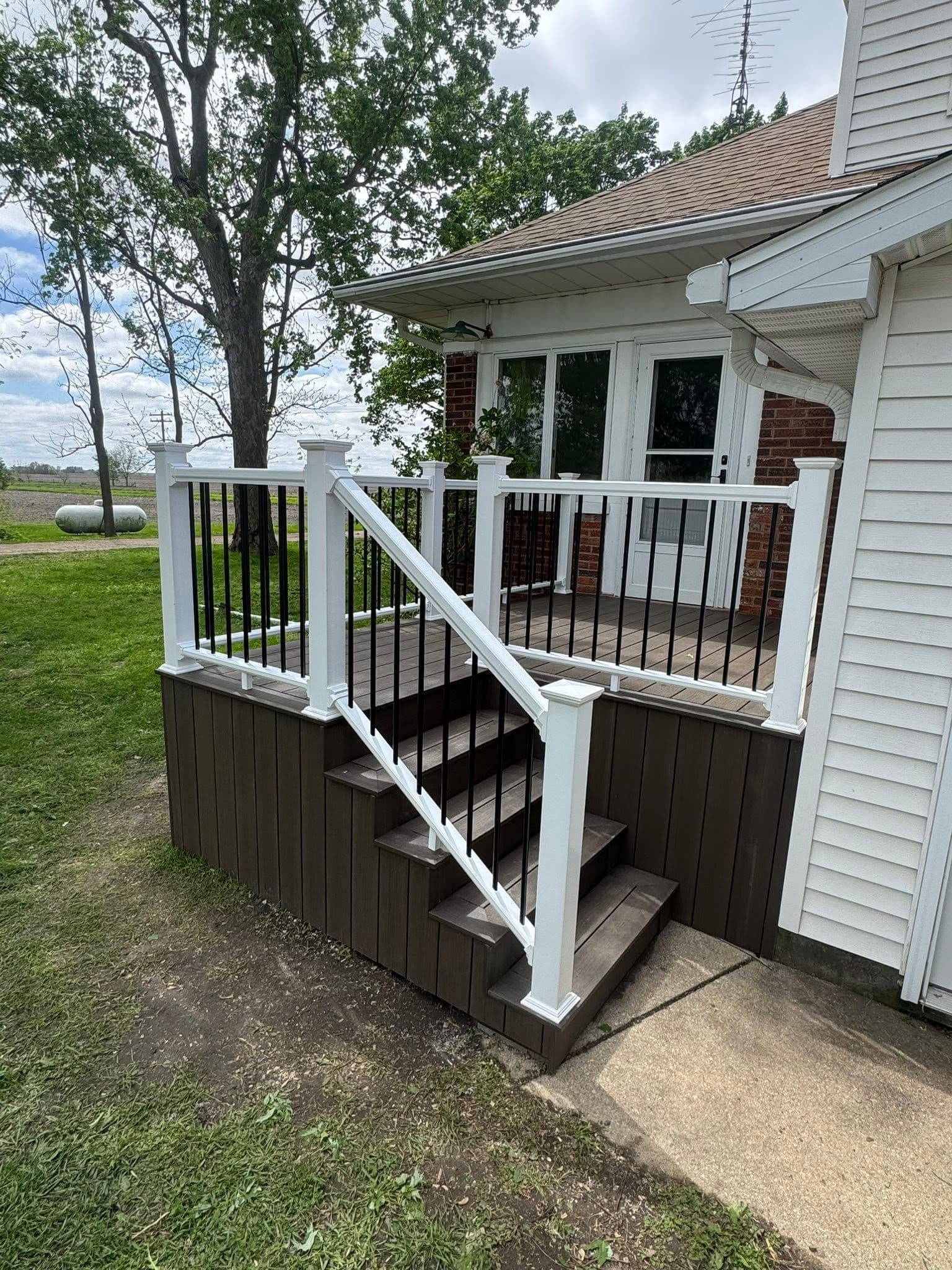
The common version is composite on everything you walk on, meaning the deck surface and the stair treads, with wood used for railings, benches, privacy screens, and skirting. That puts the expensive, zero-maintenance material exactly where the traffic and the standing water are, and leaves wood in the places that stay drier, take less abuse, and are easy to refinish with a brush.
The reverse works too on some yards. Composite on the section that bakes in afternoon sun or sits under a downspout, wood on the shaded end.
The caveats:
- Two materials means two maintenance schedules. You will still be staining something every couple of years, so a hybrid does not buy you a zero-maintenance deck. It buys you a smaller job.
- Two materials means two warranty answers. Ask exactly what covers which part before you commit, because the answer is not the same for both. See the next section.
- It has to be designed, not improvised. A hybrid that reads as one deck was planned that way. A hybrid that reads as a budget compromise was decided halfway through.
Bring it up at the consultation as a real option rather than a fallback. On a budget that will not stretch to all composite, it is usually a better answer than dropping the whole deck down to wood.
Wood has no warranty behind it
Here is the catch, stated plainly, because you will not find it on most contractors’ deck pages.
Xcel’s craftsmanship warranty on installation excludes wood. That exclusion is on this page, in the same size type as everything else, instead of in a document you read after signing.
The limited lifetime manufacturer warranty referenced elsewhere on this site covers non-wood fence materials. It is a fence materials warranty. It is not a decking warranty and it should not be read as one.
On the composite side, the boards carry the manufacturer’s own warranty. That is the manufacturer’s promise about the product, separate from anything the installer covers, and the terms vary by board line. Ask for the specific warranty document on the boards in your quote, and read what it excludes.
So a homeowner choosing wood is choosing the material with no warranty standing behind it from either direction.
That is not a reason to talk you out of wood. Wood decks have been good decks for a long time, they still are, and there are yards where wood is clearly the right call. It is a reason to know exactly what you are choosing before you choose it, so nothing about it is a surprise in year four.
Before you sign anything, ask what the craftsmanship warranty covers on your specific build, and get the answer in writing next to the rest of the scope. Ask that of any contractor. Ask it here too.
Related questions
Does composite decking get hot in the sun?
Yes, and generally hotter than wood in the same conditions. Darker colors get hotter than lighter ones. If the deck faces south with no shade and you walk it barefoot, ask to hold a sample that has been sitting in the sun before you commit to a color. It is a real consideration and it is easy to test.
Can a deck be part wood and part composite?
Yes, and it is worth asking about. The usual split is composite on the walking surface and stairs, with wood on railings, benches, and skirting. It puts the money where the traffic is. Just know you are keeping a maintenance schedule on the wood portion, and confirm what the warranty covers on each part.
How long does a wood deck last in Illinois?
Published estimates put wood decking at 10 to 15 years, and where a given deck lands in that range is decided almost entirely by maintenance. Freeze-thaw cycles here are hard on any board that has been left to soak up water. A deck that is washed and recoated on schedule reaches the top of that range. One that is never touched does not get close.
Does composite decking need sealing or staining?
No. Composite is not sealed or stained, and staining it is not an option later either. Regular cleaning is the whole maintenance program. That is the feature you are paying for up front.
Do you install composite fencing?
No. Xcel installs wood, vinyl, aluminum, and chain-link fencing. Composite here is a decking material and not a fence material, and the two get confused often enough to be worth stating outright. If low maintenance is what you are after in a fence, vinyl is the material to ask about.
Xcel Outdoor Living builds fences and decks across Bureau, LaSalle, Putnam, Marshall, and Lee counties, Illinois. Call 815-579-2323 to stand in your backyard and talk it through.