

Chain-link fence installation for a yard that needs containing.
Chain-link is the one fence we build that gets chosen for what it has to do rather than for how it looks. A dog that has learned how to leave. A toddler and a road. A vegetable garden the rabbits have already found. Xcel Outdoor Living installs galvanized and black vinyl-coated chain-link out of Spring Valley, Illinois, across Bureau, LaSalle, Putnam, Marshall and Lee counties. Posts go in below the frost line, and the fabric gets stretched rather than hung.
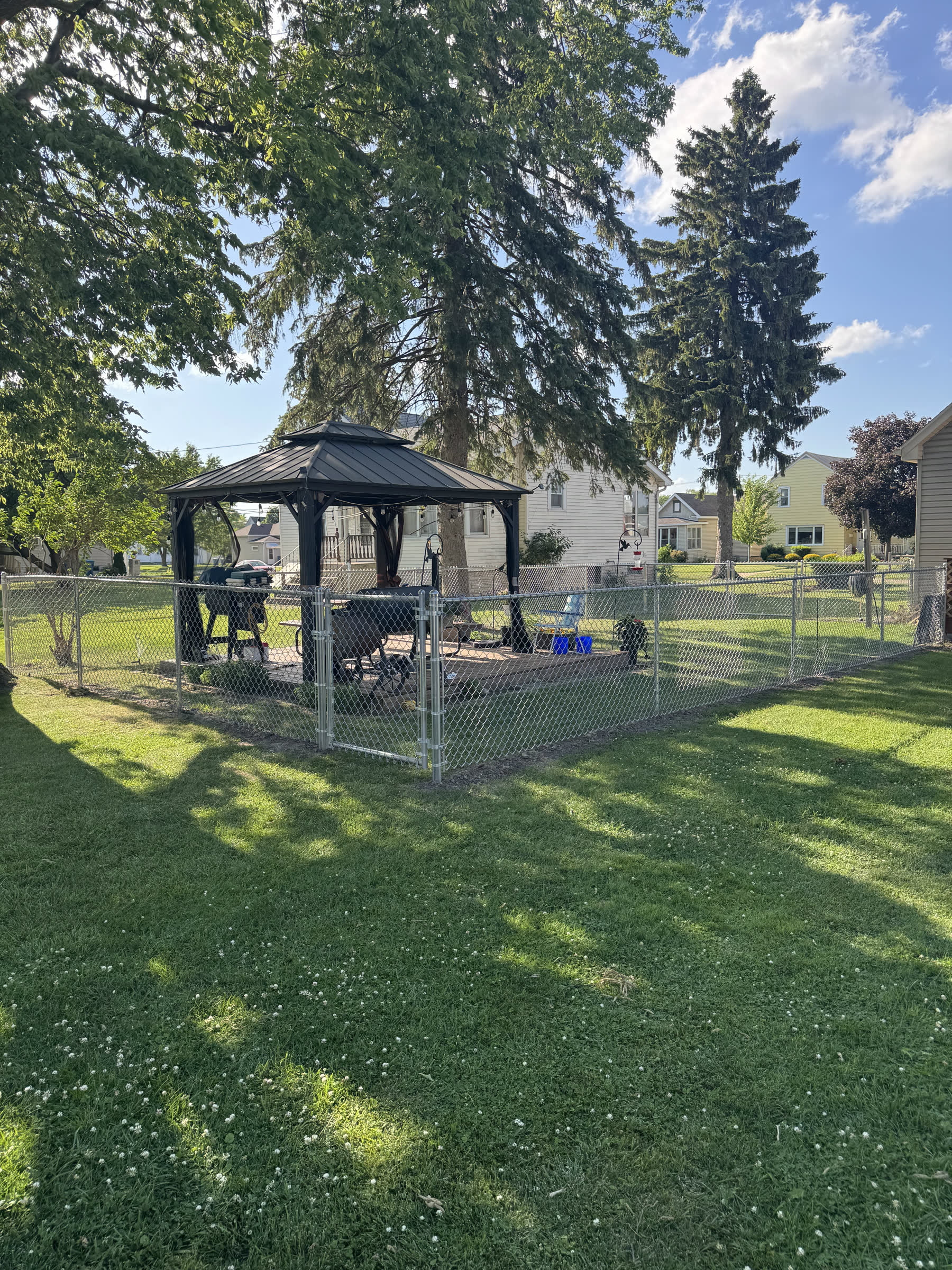
Galvanized enclosure · Illinois Valley
The fence you buy for a reason.
Every other fence we build gets picked partly for how it looks. Chain-link gets picked because something has to be contained, and usually because it has to be contained soon. That is a different conversation, and it deserves a straight one.
It is the most economical fence we build, and that is usually part of why it is on the table. Nothing is wrong with that being the reason. Built properly, a chain-link fence does its job for decades, and the job is a real one.
It is not a lesser choice in the paperwork either. Chain-link is not wood, so both warranties reach it: a limited lifetime manufacturer warranty on the materials, backed by the manufacturer rather than by us, and our craftsmanship warranty on the way it was installed.
Get a free estimateWhat it is, and what it is not
The quickest way to pick a material is to say out loud what the fence has to stop. Most of the time the answer chooses for you.
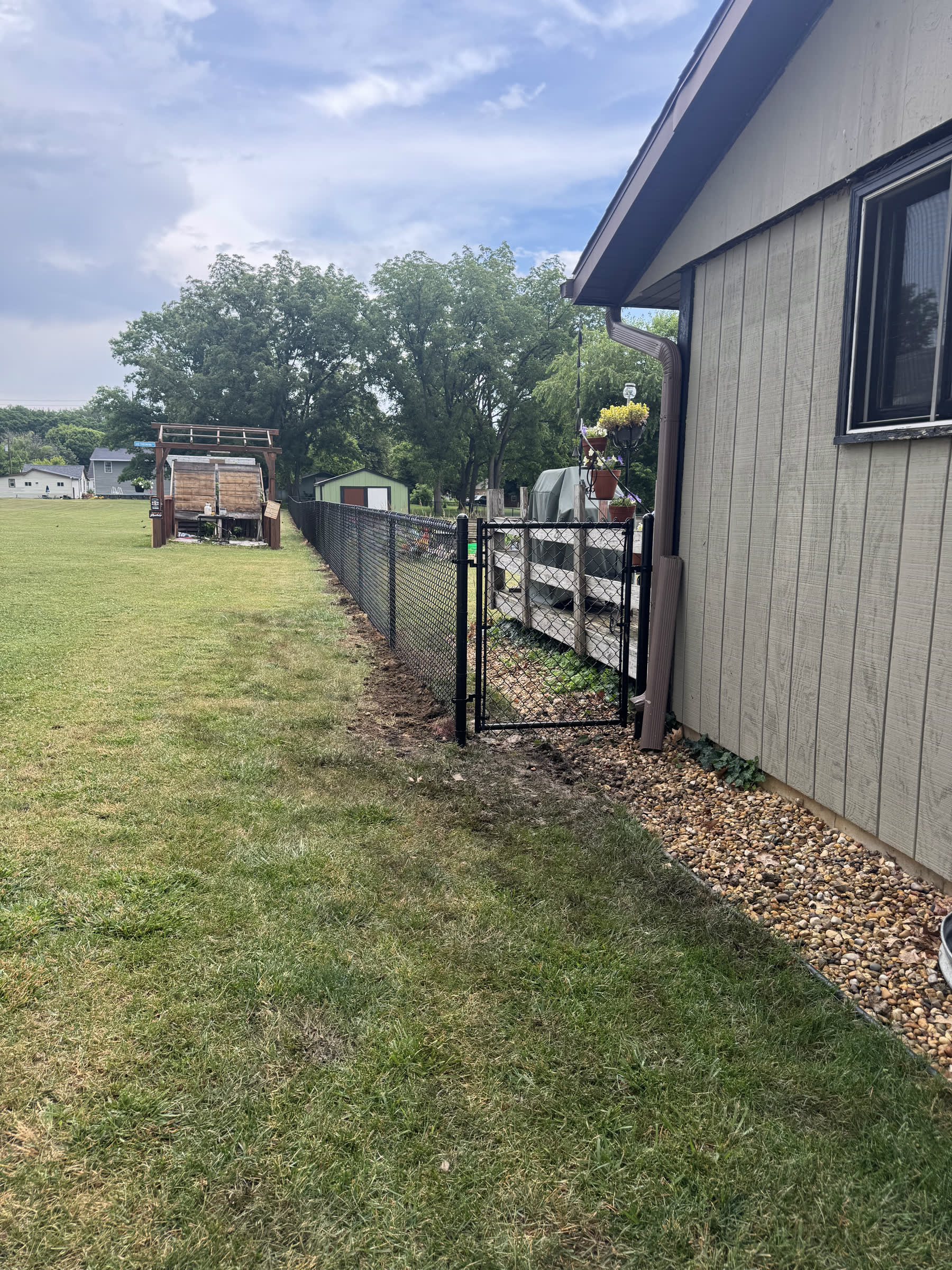
Black vinyl-coated
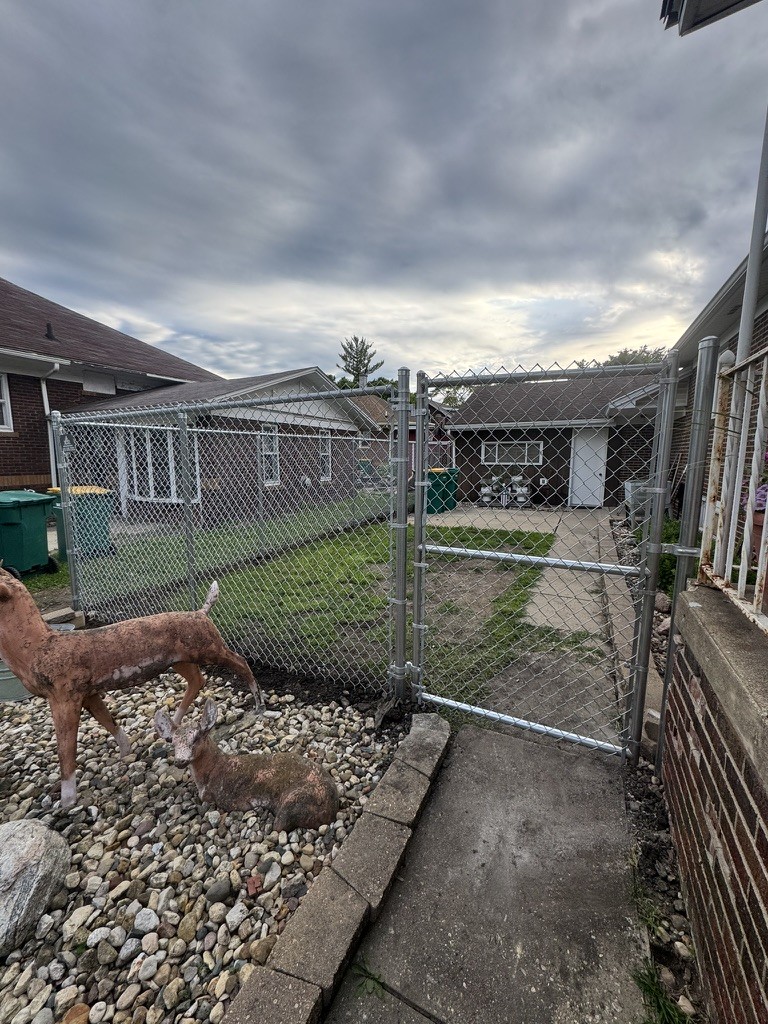
Galvanized
Galvanized or black vinyl-coated.
This is the decision you actually make on a chain-link fence, and it is not really a decision about strength. Both are steel. Galvanized wire is coated in zinc. Vinyl-coated wire is that same galvanized wire with a bonded color coat over the top of it, usually black.
What you live with is how each one reads in a yard. Galvanized is bright. It catches the light and draws a silver line across the lot, which is exactly right when the point is to show where your ground ends. Black does the opposite. Follow the fence in the left photograph toward the trees and watch it go quiet: what you are left looking at is the yard.
They age differently rather than better and worse. Galvanized starts bright and weathers to a flat gray, and that dulling is the zinc doing its work. Black holds its color, because the color is a coat and the weather never reaches the metal. What gets a coated fence is abrasion: a trimmer line along the bottom, a mower deck, a gate leaf left to drag. Open the coat and water sits on steel at that one spot.
How a chain-link fence fails.
It does not fall over, and that is worth knowing because it changes what you should be looking at. A chain-link fence that was built badly goes soft and low rather than dramatic. By the time it bothers you it has usually been wrong for a couple of winters.
Every one of these traces back to a decision made on the day it went in, which is why the corners and the ground matter more than the mesh ever will.
All of it starts in the hole. We set posts below the frost line, which is what stops a winter pushing a post up and leaving the run out of plumb for good. It is also the one part of the job nobody can inspect once the fence is standing, so it is worth asking about while there is still a hole in the ground to look at.
Where it goes soft
- Slack fabricPush the mesh with your knee in the middle of a bay. It should give and come back. Fabric that stays pushed in was hung rather than stretched, and it only gets looser from there.
- A wandering top railA wavy top rail is almost never the rail. It is a post that has moved, or a line that was never straight to begin with. Straightening the rail on a leaning post fixes nothing.
- The gate postA gate hangs its whole weight on one post and levers it every time somebody walks through. If that post is not braced for the load it drifts toward the latch, and the gate starts needing a lift to catch. That is a post problem, not a hinge problem.
- The bottom edgeA dog does not climb, it digs, and it digs at the low point where the water already runs. A bottom edge with nothing holding it down is the gap it finds first.
What tells a good one from a cheap one.
From ten feet away two chain-link fences look the same. Three things separate them, and all three can be checked by somebody standing in a yard with no tools at all.
- Post spacing, and whether it holds. Bays that wander wider are fabric being asked to carry itself. Ask what the spacing is on your run, and whether it changes on a slope or coming into a corner.
- Corners, ends and gate posts. Every direction change and every stop is where the pull ends up. Those posts should be heavier than the line posts and braced back into the run. A bare corner post with nothing bracing it is the first thing to lean.
- How the fabric is tensioned and tied. It should be stretched before anything fastens it, with a tension bar through the end and ties along the line. A fence pulled tight by hand and hooked on will tell you inside a season.
Ask for those three in the scope of work rather than as a price breakdown. A number split into categories tells you what things cost. A specification tells you what you are getting.
Words on a chain-link quote
- FabricThe mesh itself. It is called fabric because it arrives in a roll and has to be stretched, which is the whole reason tension matters.
- Terminal postAny post that ends something: a corner, a gate, the end of a run. All the pull in the fabric finishes there, so it is heavier than the posts in between.
- Tension barA flat bar woven down through the last row of mesh and banded to the terminal post. It turns the loose end of a roll into a fixed edge.
- Top railThe pipe running along the top and carrying the fabric with it. It is what makes a long run read as a line instead of a wave.
- Tension wireA wire run along the bottom to hold the bottom edge down. It is the answer to the gap a dog goes looking for.
Questions that come up on a chain-link job.
Will a chain-link fence keep my dog in the yard?
The middle of a chain-link fence is rarely what fails. The bottom edge is. A dog works the low spot where water already runs, so the grade under the run and what holds the bottom edge down are the things worth talking about. Tell Jake what your dog actually does while he is walking the line with you, because a digger and a jumper are two different fences.
Galvanized or black vinyl-coated: which should I pick?
Both are steel and both last, so the choice comes down to how each one sits in a yard. Galvanized is bright, and it draws a clear line where your property ends. Black recedes, especially against trees or a shaded fence row, so what you notice afterwards is the yard rather than the fence. Whichever you pick, get the words for it written into the scope of work. They are not the same product and they should not be described by the same sentence.
Will a chain-link fence look cheap in my yard?
It looks like what it is, and it will never pretend to be a privacy fence. What changes the impression is the finish and the line. Black against a treeline is close to invisible from the house, and a run that is genuinely straight with the top rail holding its line reads as deliberate rather than as whatever was cheapest. If how it looks matters more to you than what it contains, say so at the estimate, because that usually points at a different material.
Can chain-link follow a slope?
Better than most fences, because it is fabric rather than panels. The run can follow the grade the whole way down instead of stepping it in flat sections, so there is no triangle of daylight left under the bottom edge at the low end. That happens to be the exact piece of ground a dog will test first.
What will a chain-link fence need from me over the years?
Not much. There is nothing to stain and nothing to seal. Galvanized dulls from bright to a flat gray as the zinc weathers, which is the coating working rather than failing. Black keeps its color, and the thing to watch there is the coating itself: a trimmer line, a mower deck, or a gate leaf allowed to drag will open it, and an opening is where water finds the steel. The gate is the part that earns your attention, because it is the only part with moving hardware on it.
Is chain-link covered by the warranty?
Yes, by both of them. Chain-link is not wood, so the materials carry the limited lifetime manufacturer warranty, which is backed by the manufacturer rather than by us, and our own craftsmanship warranty covers defects in how we installed it. What that second one does not cover is settling, weather, impact or ordinary wear.
If chain-link is not it, here are the other three.
Chain-link is the one you buy for a reason. If the reason turns out to be privacy, or the look of the thing from the street, one of the other three is the better answer.
Let’s walk the line you need closed.
The estimate is free. Jake comes out, walks the run with you and reads the ground while he is there. The number comes after, with the rock already priced into it.
Monday to Friday, 7:00 AM to 5:00 PMCall any time.We’re usually booking a few weeks out.
Limited lifetime manufacturer warranty on non-wood fence materialsCraftsmanship warranty on our deck builds and non-wood fence installsFully insured & registered