

Aluminum fencing for Illinois Valley yards that are not flat.
Aluminum is the fence you specify when the ground moves under it and when the point of the line is to mark something rather than to hide behind it. Powder-coated picket, usually black. Xcel Outdoor Living builds out of Spring Valley, Illinois and installs across Bureau, LaSalle, Putnam, Marshall, and Lee counties.
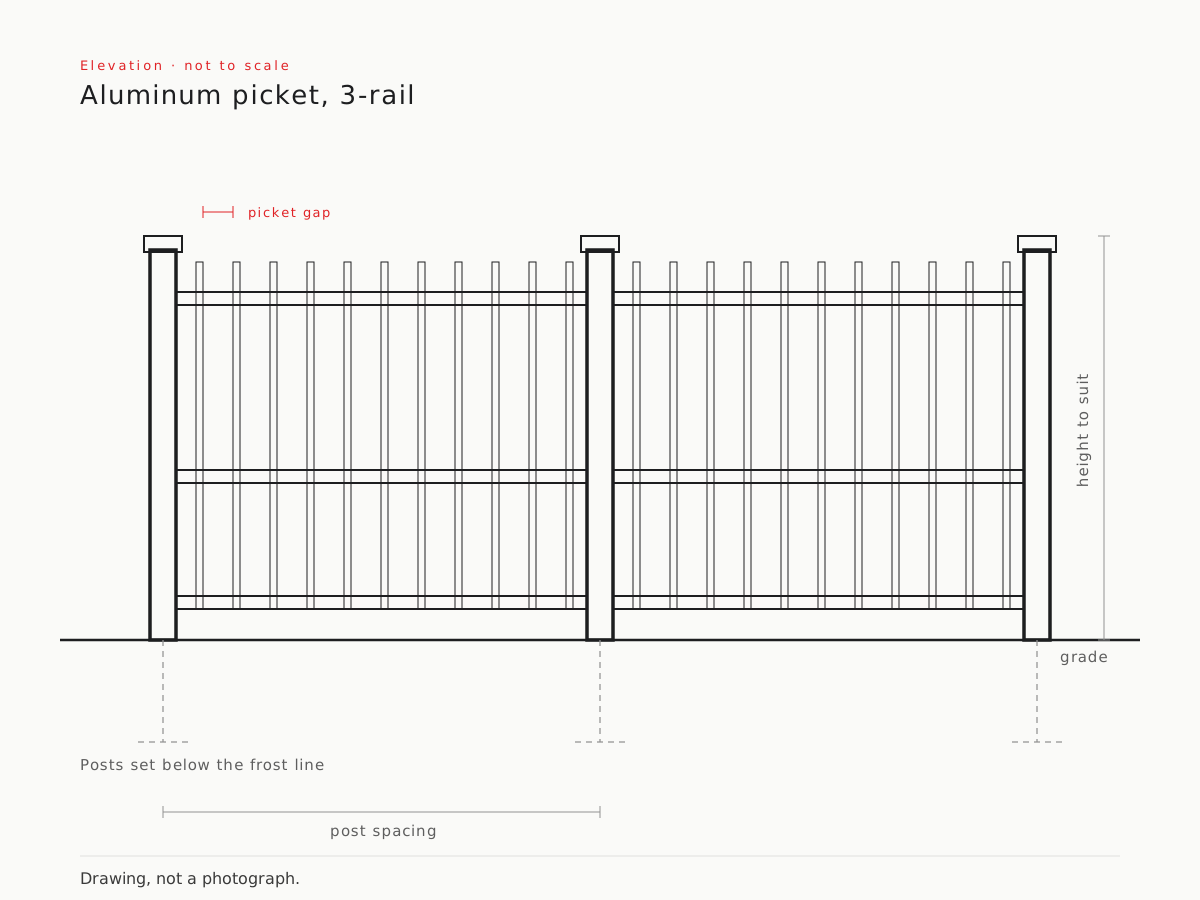
Aluminum is the one fence we have not photographed yet, and borrowing somebody else’s is not on the table. So here is the panel drawn: three rails, the picket spacing, and where the run meets the ground. A photograph would show you a fence. This shows you how one is put together.
How the panel goes together.
Drawing, not a photograph
Ground that rolls has two answers.
Almost nothing around here is dead level. What a fence does about that is settled before anybody digs a hole, and it comes down to two choices: rack the panel, or step it.
Racking means the rails pivot where they meet the post. The pickets stay plumb, the rails run parallel to the ground, and the top of the fence falls at exactly the rate the yard does. From the back door it reads as one line following the land.
Stepping means each panel stays dead level and drops to the next like a staircase. It is the only answer a rigid panel can give, which is why a vinyl privacy run steps. The top becomes a set of horizontals, and under the low end of every panel a wedge of daylight opens up.
Aluminum is the material that lets you choose. On ground that falls steadily, that choice is worth having.
- Racking has a limit. A panel only pivots so far, so a yard that drops away sharply at one point instead of falling steadily needs a step there whatever it is built from.
- A step is the right answer against something that is already level: the edge of a patio, a retaining wall, a run of steps.
- A dog finds the wedge before you do. On a steady fall a racked run holds the same small gap the whole way, and that is usually the real reason somebody asks for it.
Which one your yard gets is settled standing in it. The estimate is free and Jake is the one who comes out to read the ground.
Have him walk your slopeRacked against stepped
Not every fence is trying to hide you.
Privacy is why most people call, and for most of them it is the right reason. This is the other one. A picket line marks where the property starts, keeps in what needs keeping in, and leaves the view alone.
That changes what good looks like. Against a tree line at dusk a black picket reads as a line and then stops asking for attention; a white one never stops. It is the same reason a black rail on a deck steps back and a white one becomes the first thing you see.
Going around a pool, say so early. A pool barrier answers to your village or county rather than to a fence catalogue: the rules there set the height, the gap between pickets, how high the latch sits, and whether the gate has to swing shut and catch on its own. Confirm yours before anything is ordered. We pull the permit, and the village sets the numbers on it. Knowing them first is what stops a fence being built twice.
Who to ask, and what they ask forIf what you actually want is to stop seeing the neighbors, that is a different fence and it has a page of its own.
Vinyl privacy fencingWhat a line like this is for
A privacy panel wants to be solid. This wants to disappear, and black is the color that does it.
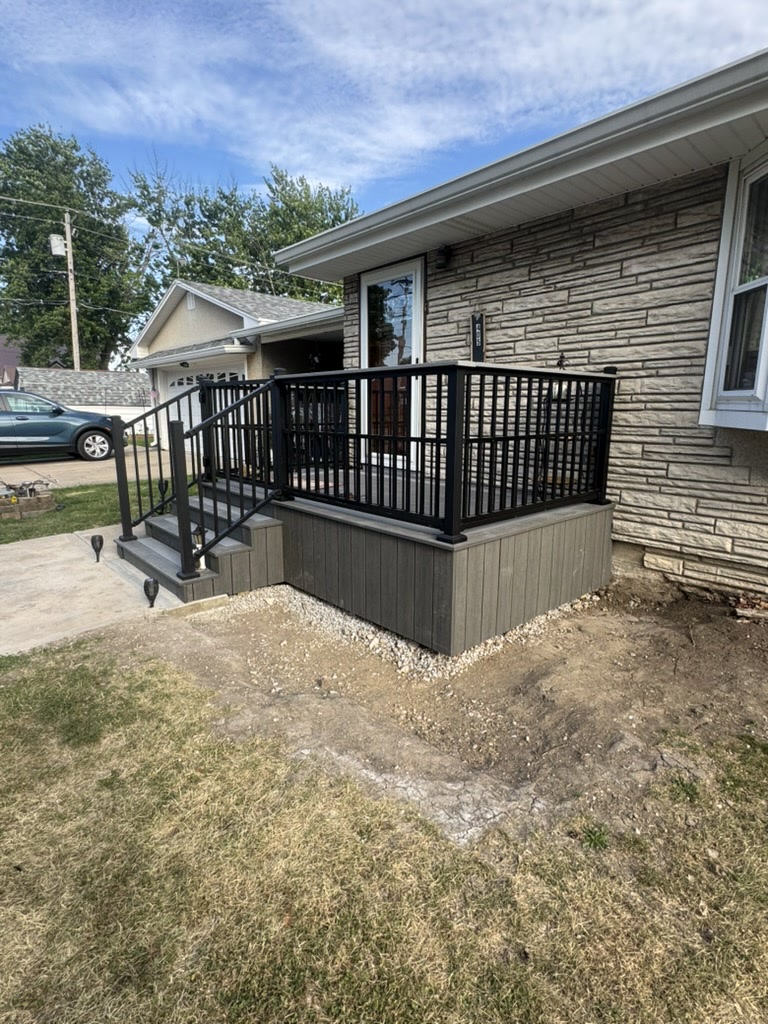
Aluminum deck railing, not fencing · Illinois Valley
No rot, no stain, no repaint.
The color is not paint. It is a dry powder laid onto the metal with an electrostatic charge and then baked until it flows out into one continuous skin. There is no brush film to lift at an edge and nothing to peel.
Rust is iron, and aluminum has none in it, so the posts, rails and pickets do not go orange. A bare spot grows a thin gray oxide instead, and that oxide stops where it started rather than creeping along underneath. It is the opposite of what a painted steel fence does at a cut edge.
Ten years of Illinois sun takes a little gloss off a powder coat. It happens slowly and evenly across the whole run, so it reads as the fence settling in rather than as a fault. The color holds. Nothing flakes.
The problem is a scratch. A string trimmer at the base, or a mower catching a picket, takes the coating through to the metal, and what shows underneath is bright silver against black. It will not rust and it will not spread, but it does not go away either, and touch-up never matches the sheen of a baked finish. Wood you sand and re-stain. This you either live with or you swap the picket.
Everything else it wants is a hose, plus a rinse on the run beside the driveway once the salt is off the roads.
What a written specification should tell you Ask what we would put in your yardWhere an aluminum fence gives out first.
Every material fails in its own way and it is worth knowing which way before you own one. On aluminum it is these three, roughly in this order.
- The gateA gate is the only part of a fence with moving parts, and it is the part that tells you how old the fence is. Hinges wear, the latch stops meeting square, and a gate that has dropped a fraction will still swing but will not catch. It is the first thing to go and look at on any fence you are being shown, ours included.
- A picket that takes a hitAluminum is soft. A mower deck or a string trimmer will dent or bend a picket where something heavier would shrug it off. The useful half is that a picket is its own part, so the damage stops where it happened instead of running through the panel. The coating breaks at the dent, and bright metal against black is not subtle.
- A post in ground that movesThe one that actually ruins a fence, and the reason the holes go below the frost line. Frost lifts a shallow post and spring does not put it back. It happens a little each winter and it only ever goes one way. On a fence you can see through it shows sooner than on a solid one, because you read every picket against the two beside it: a post that has shifted is obvious from the far side of the yard.
None of those three is automatically a warranty claim.
Our craftsmanship warranty covers defects in how we installed it, and not settling, weather, impact or ordinary wear. The limited lifetime manufacturer warranty covers non-wood fence materials and is backed by the manufacturer rather than by us.
Aluminum is inside both of them. Told to you now, next to the three ways it gives out, rather than found later in a document you were handed on the last day.
Wood is the one material inside neither.
Get a free estimateIf aluminum is not it, here are the other three.
Vinyl if the point is privacy. Chain-link if the point is containment and nothing else. Wood if you want to pick the height, the boards and the color yourself. Each one has a page, and the hub sets all four side by side.
All four on the fencing pageWhat people ask about aluminum.
Will an aluminum fence follow my slope, or does it have to step down it?
It can do either, and aluminum is the material that gives you the choice. A racked panel pivots at the post so the rails run parallel to the ground while the pickets stay plumb, which keeps the whole run tight to the grade. A stepped panel stays level and drops at each post instead, which opens a wedge of daylight under the low end of every bay. Steady ground usually racks. A sharp break in the ground steps whatever it is made of. Which one your yard gets is settled standing in it: Jake walks the line with you before anything is priced.
Can I put an aluminum fence around a pool?
People do, and being able to see the water from the house is usually why. What the fence has to be is not decided by the material though. A pool barrier answers to your village or county: the rules there set the height, the gap between pickets, how high the latch sits, and whether the gate has to swing shut and catch on its own. Confirm yours with the village before anything is ordered and bring the numbers to the walkthrough. We pull the permit, and the village sets what goes on it.
Does aluminum fencing rust?
Rust is iron, and aluminum has none in it, so the posts, rails and pickets do not go orange. A bare spot grows a thin gray oxide instead, and that oxide stops where it started rather than creeping along underneath the finish. It is the opposite of what a painted steel fence does at a cut edge, and it is most of the reason people choose aluminum for the bottom rail of a fence that sits in wet grass.
What does an aluminum fence ask of me?
A hose, and not much of one. There is nothing to stain, nothing to seal and no repaint cycle. The one seasonal job worth doing is rinsing a run that sits beside a driveway once the salt is off the roads. Ten years of sun takes a little gloss off the finish, evenly across the whole run rather than in patches, and that is the extent of what weather does to it.
What happens if a picket gets damaged?
Aluminum is soft, so a mower deck or a string trimmer will dent or bend a picket rather than bounce off it. The useful half of that is that a picket is its own part: damage stops where it happened instead of running through the panel. The unwelcome half is that the coating breaks at the dent, and bright metal against black is not subtle. It will not rust and it will not spread, but it does not fade away either, and touch-up never quite matches the sheen of a baked finish.
Is aluminum covered by your warranties?
Yes, by both, and that is not true of everything we build. The limited lifetime manufacturer warranty covers non-wood fence materials, and aluminum is non-wood, so it is in; the manufacturer stands behind that half rather than we do. Our own craftsmanship warranty covers defects in how we installed it, and not settling, weather, impact or ordinary wear. The one material that sits outside both is wood.
Let’s go and look at your ground.
The estimate is free and Jake comes out. He walks the line with you, reads what the ground is doing, and tells you whether your yard racks or steps. The number comes after.
Monday to Friday, 7:00 AM to 5:00 PMCall any time.We’re usually booking a few weeks out.
Limited lifetime manufacturer warranty on non-wood fence materialsCraftsmanship warranty on our deck builds and non-wood fence installsFully insured & registered